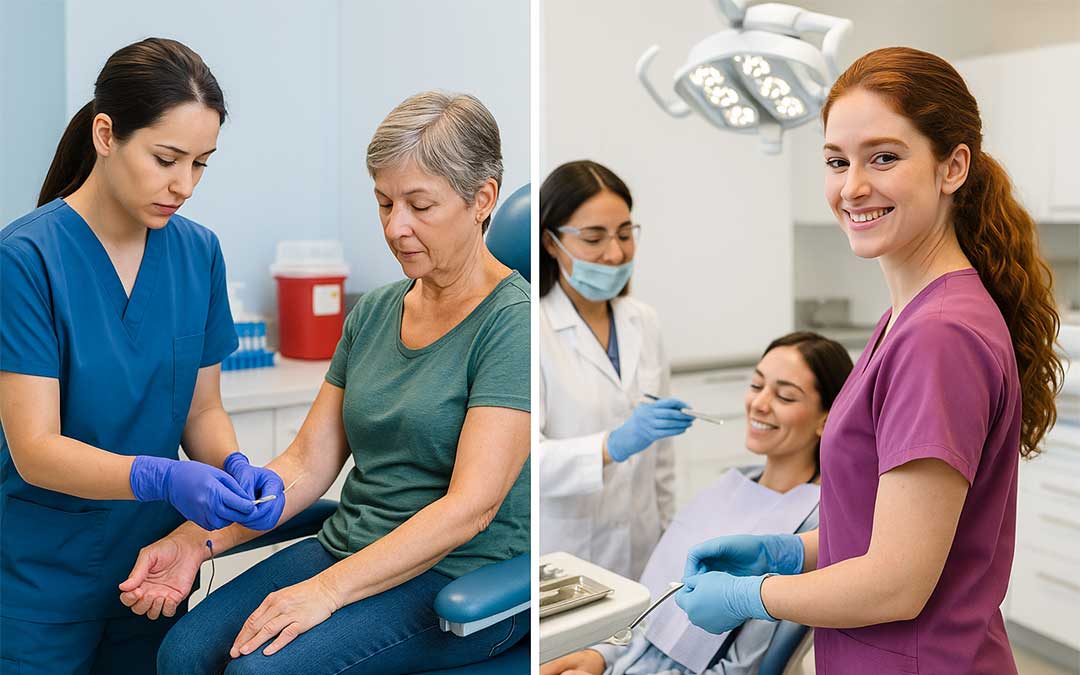
If you’re exploring entry-level healthcare careers that don’t require a four-year degree, two common paths often come up: dental assisting and phlebotomy. Both offer quick training, patient interaction, and the opportunity to work in a respected medical setting.
But if you’re thinking long term, considering flexibility, schedule, career advancement, and job satisfaction, dental assisting often provides a stronger foundation for a lasting career.
This side-by-side comparison will help you decide which path better fits your goals.
Education and Certification: How Quickly Can You Start?
Both dental assisting and phlebotomy offer fast training options for students who want to enter the healthcare field without spending years in school.
Phlebotomy programs typically range from 6 to 12 weeks and focus on core skills like blood draws, lab safety, and specimen handling. Some more intensive programs may last up to 6 to 8 months, especially when paired with clinical externships. For those pursuing an associate degree in a related field, the total time investment can extend to two years.
Dental assisting programs, like the 12-week course at Pacific Northwest Dental Assisting School, provide comprehensive training that prepares students for a wider range of clinical and administrative responsibilities. In addition to hands-on chairside experience, students learn dental radiology, infection control, sterilization protocols, charting, and patient communication all essential for working in modern dental offices. Students gain hands-on experience in:
- Chairside assistance
- Radiology and X-rays
- Infection control and sterilization
- Charting and scheduling
- Patient education and intake
Although the training period is slightly longer, dental assisting provides a broader skill set that increases your long-term value in the workforce.
Scope of Work: What Will You Do Day to Day?
Phlebotomists specialize in drawing blood and preparing samples for testing. Daily tasks usually include identifying veins, performing clean draws, labeling samples, and following strict safety procedures. While the job is focused and important, it tends to be repetitive and high-volume, especially in busy hospitals or diagnostic labs.
Dental assistants perform a wider range of responsibilities throughout the day. Depending on the office and your experience, you might:
- Set up treatment rooms
- Assist the dentist with procedures
- Take and develop X-rays
- Sterilize and organize tools
- Educate patients on post-treatment care
- Help with front desk tasks such as scheduling
For those who want more variety and teamwork throughout the day, dental assisting offers a more diverse and engaging experience.
Work Environment and Schedule
Phlebotomists often work in large healthcare systems such as hospitals, outpatient labs, and blood donation centers. These environments can be fast-paced and require rotating shifts, including nights, weekends, and holidays.
Dental assistants generally work in private dental offices or dental group practices. These offices tend to operate during standard weekday hours. That means:
- No late-night shifts
- Weekends and holidays off
- A more predictable, family-friendly schedule
If work-life balance is important to you, dental assisting usually offers a more structured routine with fewer schedule disruptions.
Career Advancement and Growth Potential
Phlebotomy is a critical skill but offers limited room for advancement unless you return to school to become a medical lab technician or move into nursing or another healthcare profession.
Dental assisting creates opportunities for continued growth within the same field. Many dental assistants choose to:
- Become Expanded Function Dental Assistants (EFDA)
- Specialize in orthodontic or surgical assisting
- Move into office management or treatment coordination
- Apply to dental hygiene programs
- Teach in dental assisting programs
Dental assisting allows you to gain new responsibilities and credentials over time without having to completely switch careers or return to full-time schooling.
Salary and Job Outlook
Both careers have a similar job outlook, with projected growth between 7 and 8 percent over the next decade according to the U.S. Bureau of Labor Statistics. Pay varies depending on location and experience, but in general according to the BLS Occupational Outlook Handbook for Phlebotomists, the median salary is approximately $43,660 per year, with demand expected to remain steady through 2034.
| Career | Median Salary | Work Schedule | Advancement |
| Phlebotomist | ~$43,660 per year | Variable, includes nights and weekends | Limited without further education |
| Dental Assistant | ~$47,300 per year | Primarily weekdays, regular hours | High, especially with certifications |
Dental assistants often receive raises as they take on more duties, and many enjoy long-term job stability in private practice settings. The BLS page for Dental Assistants reports that the median annual wage is about $47,300, with consistent demand across private practices and specialty clinics.
Which Career Path Fits You Best?
Phlebotomy may be right for you if:
- You want a very quick training program
- You’re comfortable with highly repetitive tasks
- You don’t mind working in hospital or lab settings
- You’re open to shift work and weekend hours
Dental assisting may be a better fit if:
- You want a stable schedule and predictable hours
- You enjoy working closely with both patients and team members
- You want the option to advance your career over time
- You’re looking for long-term employment in a private, team-focused setting
A Real-World Perspective
It’s common for prospective students to start by looking at phlebotomy due to the shorter training time. But many discover that while it’s a quick path into healthcare, it can lack the long-term growth and variety they really want.
Some phlebotomists even return to school to become dental assistants because of the better hours, stronger patient relationships, and broader career options.
Get Started with Dental Assisting in Just 12 Weeks
At Pacific Northwest Dental Assisting School, students can complete their dental assisting training in as little as 12 weeks. With evening and weekend lab sessions, the program is flexible enough for working adults, parents, and anyone seeking a practical career shift.
Graduates leave with the skills and confidence to work in real-world dental settings, ready to start a career that offers stability, teamwork, and the opportunity to grow. Ready to learn more? Contact us to ask questions, view upcoming class dates, and take the next step toward a career that fits your goals for the long run.
