Quick Summary
Pacific Northwest Dental Assisting School’s 12-week program is a hybrid of online lectures and in-person labs that packs 144 classroom hours and a 50-hour hands-on internship into a single accelerated season. You finish with a dental assistant certificate and CPR certification, ready to start working far sooner than programs that run up to a year. Week by week you move from tooth anatomy and OSHA safety into radiography, restorative procedures, temporary crowns, and assisting in dental specialties. The radiography training is Oregon board approved for radiation health and safety, which makes graduates eligible for the Oregon X-ray Test. Best of all, your internship happens at the school’s own on-site dental practice, so you never have to hunt for a placement. Here is exactly what you learn and when.
- Twelve weeks, hybrid format: online lectures plus in-person labs and 144 classroom hours.
- A 50-hour internship at the school’s on-site dental practice, no outside placement to find.
- Graduate with a dental assistant certificate and CPR certification in hand.
- Radiography training is Oregon board approved, making you eligible for the Oregon X-ray Test.
How the 12-week hybrid program is structured
The program is built to get you trained and working quickly without cutting corners. It blends online lectures with in-person labs, so you get flexibility for the classroom side and real hands-on time for the clinical side. In total you complete 144 hours of classroom study plus a 50-hour internship, and you can read the full program course outline for the session schedules.
The pace is the point. Many dental assisting programs stretch across a year or more, while this 12-week accelerated path lets you earn your certificate and start your career in a single season. The hybrid online and in-person format is what makes that speed possible while still giving you the lab time the work demands.
Week by week: what the program covers
The first weeks ground you in the fundamentals. You start with an introduction to dental assisting and tooth anatomy, then move into OSHA training and dental impressions, followed by preventative care and coronal polishing. Week four is radiography safety and techniques, where you learn to take and develop dental x-rays.
From there the training turns clinical and hands-on. You cover moisture control and four-handed dentistry, then pain and anxiety control, then restorative dentistry with composite fillings, and provisional coverage, which means making temporary crowns. The final stretch broadens your scope: dental specialties and periodontal assessment, endodontics, and medical emergencies, before checkoffs and graduation prep in weeks eleven and twelve. By the end you have touched nearly every task you will see chairside.
The core skills you build
Behind the weekly topics are the practical skills that make you valuable on day one. You learn to sterilize and prepare a treatment room, perform mouth rinses, and handle a range of dental instruments. You learn to take and develop dental x-rays, work with dental cements and impressions, and assist with restorative care using amalgam and composite fillings, including creating temporary crowns.
The training also puts you alongside the dentist for specialized procedures such as oral surgery, root canals, scaling, and denture placement, and into cosmetic dentistry, where you make a custom night guard and a tooth-whitening tray. On the radiography side, the course is approved by the Oregon Board of Dentistry for radiation health and safety, which makes you eligible to take the Oregon X-ray Test. You also earn CPR certification from the school’s instructors.
How those skills map to the actual job
Everything in the program points at the real duties of a dental assistant. According to the U.S. Bureau of Labor Statistics, dental assistants prepare patients and work areas for treatment, sterilize instruments, hand the dentist tools during procedures, take and process x-rays, and help patients with post-treatment care.
That is the same list you practice in class and lab, which is the whole idea. Rather than learning theory in isolation, you build the exact skills a practice will expect you to perform, so the jump from graduation to a paid role feels like a continuation rather than a leap. Our overview of the dental assistant career outlook shows where those skills can take you.
Your internship at the on-site practice
One of the biggest differences here is the internship. Many programs leave students to find their own dental office for hands-on hours, which can be stressful and uneven. At Pacific Northwest Dental Assisting School, you complete your 50-hour internship at the school’s own on-site practice, Radiance Dental, so the placement is handled for you.
There you work alongside Dr. Bharathi and her team of hygienists and experienced dental assistants, putting classroom theory into practice on real patients in the Vancouver area. You will disinfect treatment rooms, take and develop x-rays, create temporary crowns, make custom mouth guards and whitening trays, and assist with advanced procedures. Most importantly, you learn what it feels like to be a contributing member of a working dental practice.
Certificate, CPR, and what it costs to get there
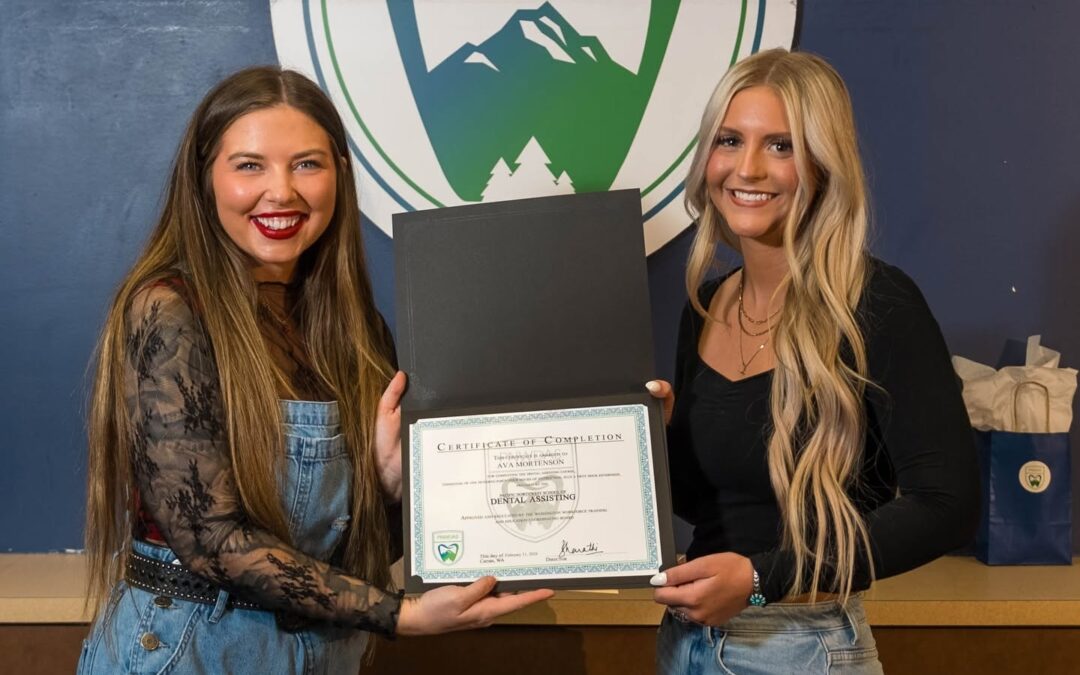
You graduate with two credentials in hand: a dental assistant certificate and CPR certification, both earned through the program. That combination, plus the radiography eligibility, is what lets you step into the job market quickly rather than waiting out a longer course.
Tuition is $6,995 total, structured as a $250 deposit followed by four installments, and flexible payment plans and financial assistance are available for qualifying students. Our breakdown of what dental assisting school costs walks through the numbers in full. With several start dates and schedules through the year, the main question is simply when you want to begin.
Ready to start your dental assisting career?
If a 12-week path to a dental assistant certificate sounds like the right move, the next step is simple. Apply to Pacific Northwest Dental Assisting School or call admissions at (360) 818-7273 to find the start date that fits your schedule.
Sources
Pacific Northwest Dental Assisting School, Program Course Outline: https://schoolofdentalassisting-vancouver.com/dental-assisting-program-course-outline/
U.S. Bureau of Labor Statistics, Occupational Outlook Handbook, Dental Assistants: https://www.bls.gov/ooh/healthcare/dental-assistants.htm
